

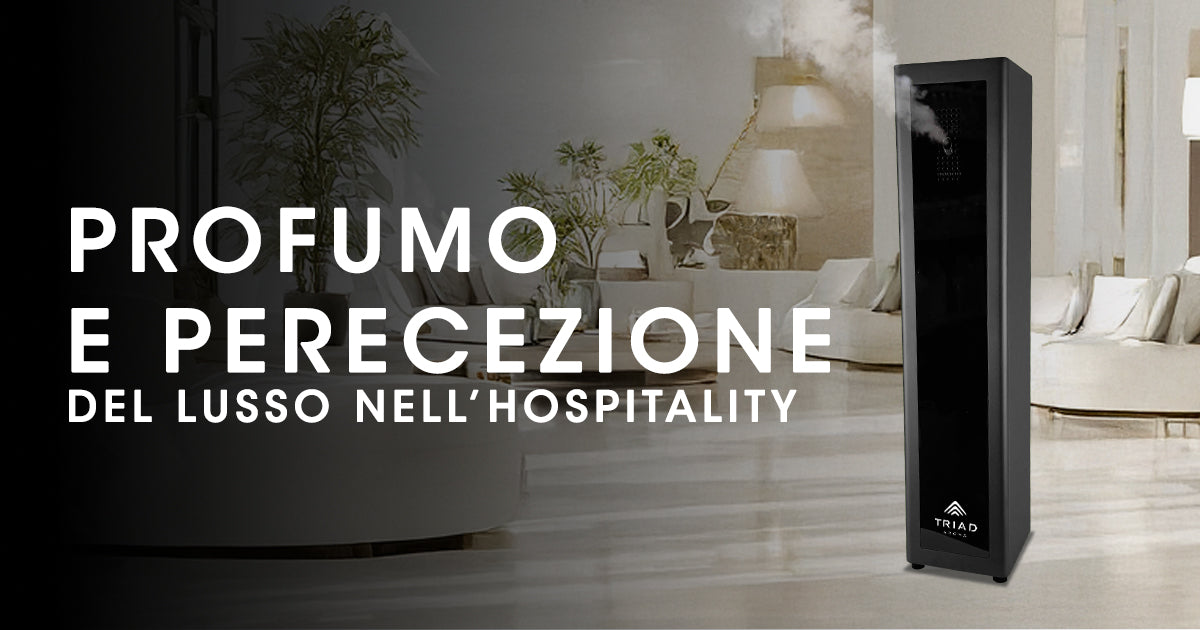
Fragrance and the perception of luxury in hospitality
Luxury is not declared. It is perceived.
In a high-end hotel, no detail is truly "secondary." Yet, what distinguishes a premium experience from one that is merely correct is not always what you see.
It is often what you feel without thinking about it: the calm with which a space welcomes you, the balance between elegance and naturalness, the sense that everything is in its right place.
Luxury, in hospitality, is not a list of amenities. It is an atmosphere.
And among the elements that build that atmosphere, fragrance is one of the most decisive and, at the same time, most underestimated.
Why the sense of smell influences perceived quality
The perception of luxury is, by definition, largely intangible. It depends not only on the objective quality of materials or the quantity of services, but on the consistency and care with which the experience is orchestrated.
Here, the sense of smell plays a particular role: it is a sense that works immediately, often unconsciously. It does not require attention, does not compete with aesthetics, does not ask to be interpreted. It simply defines a tone.
And the tone is what, in a premium context, builds trust.
When a guest enters a lobby, their mind quickly registers signals of quality: order, cleanliness, level of maintenance, attention to detail. But the overall sensation stems from a broader whole, one also made of sensory comfort. An olfactorily harmonious environment communicates:
- care (nothing is left to chance)
- consistency (the experience has a direction)
- stability (quality is not episodic, it is structural)
In an era where many high-end hotels share a similar visual language, fragrance can become a more subtle and impactful element of differentiation.
Not because it "strikes."
But because it consolidates.
Fragrance as the language of luxury: discretion, continuity, recognizability
Authentic luxury is rarely loud. It does not try to get noticed at all costs. Rather, it creates an experience that appears inevitable: natural, fluid, consistent.
In this sense, a well-thought-out olfactory signature is not a decorative addition. It is a language.
Discretion: luxury does not invade
A premium fragrance should not be "present" in the way personal perfume is. It must be calibrated: perceptible, but never intrusive. In luxury, excess is a mistake because it breaks the balance.
Discretion communicates control. And control, in hospitality, is a form of luxury.
Continuity: the experience must not break
Many hotels curate the lobby as an iconic space, but neglect the rest of the journey. Yet the guest passes through corridors, elevators, lounges, and common areas. If the atmosphere changes inconsistently, the brand becomes fragmented.
Fragrance can become an invisible thread that joins the different environments, giving continuity to the experience. A continuity that translates into higher perceived quality, because it suggests design and intention.
Recognizability: luxury is also identity
In premium, it is not enough to be "beautiful." One must be recognizable. A hotel that builds its own olfactory signature works on an element of identity that does not depend on trends, is not exhausted by a photograph, and above all is not easily replicable.
This does not mean turning the fragrance into the protagonist. It means making it a distinctive trait consistent with the character of the property.
Examples of application: how luxury changes according to the promise
Fragrance does not "create luxury" in a generic way. It interprets a promise.
- Urban and contemporary luxury: the atmosphere tends to be essential, precise, bright. The fragrance must support this clarity without weighing it down.
- Experiential boutique hotel: luxury comes through personality, storytelling, and the sense of uniqueness. Here, fragrance can become a narrative element, consistent with materials and concept.
- Premium resort and leisure: luxury is often linked to time, relaxation, and distance from the routine. The fragrance must accompany the slowing down, amplifying the feeling of a break.
- Wellness hospitality: here, luxury is balance. The fragrance is not an ornament, but part of the perception of well-being and care.
In all cases, the fragrance works when it does not "add" something, but brings coherence to what already exists: spaces, service, architecture, brand tone.
Fragrance as an indicator of care: cleanliness, order, reliability
There is an often-overlooked aspect: in hospitality, luxury is not only aesthetic, it is also trust. And trust is born from implicit signals.
An environment that conveys cleanliness and order does not do so only through polished surfaces or perfect fabrics. It does so through the overall sensation of the air as well.
A balanced fragrance can reinforce that sense of "structural care" that guests associate with premium brands: not an episodic attention, but a repeatable, reliable quality.
And what is reliable, in a hotel, is what you choose again.
Luxury is a sum of invisible choices
At Triad Aroma, we believe that luxury, in hospitality, is not a show. It is a design: made of consistent, often silent, always intentional choices.
Fragrance is one of these choices. Not because it replaces design and service, but because it completes them. Because it gives continuity to the experience. Because it contributes to transforming a premium space into a recognizable place.
Over time, guests will forget many details. But they will remember the overall sensation of that stay.
When a space is designed with intention, it does not just welcome people.
It stays with them.


