

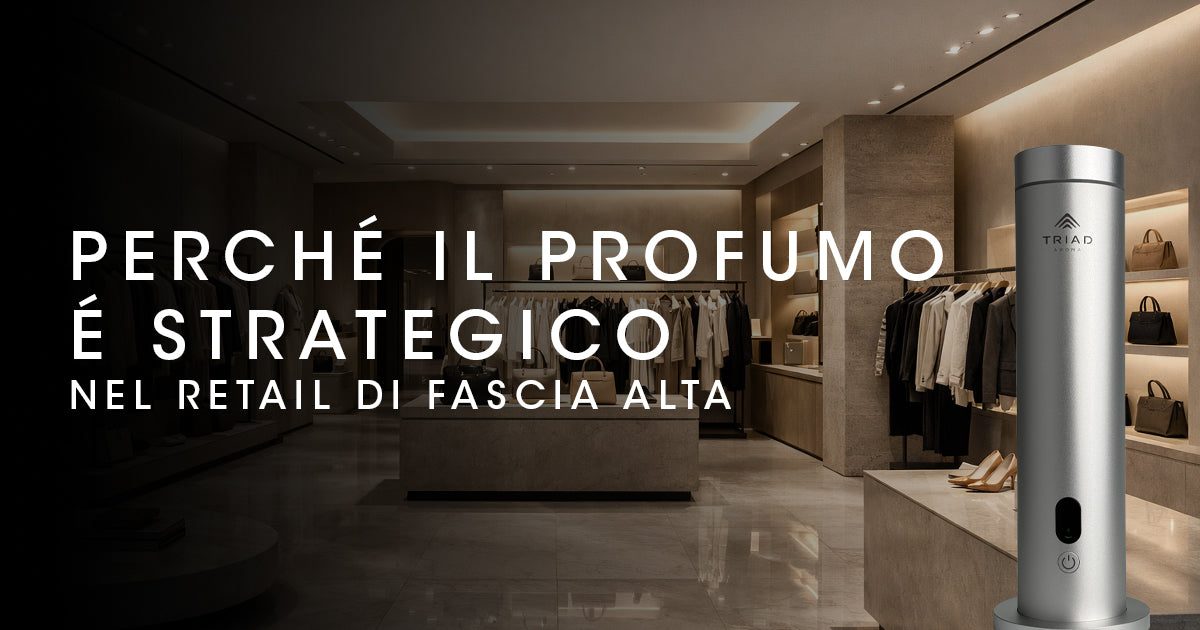
From the invisible sense to an economic lever
In high-end retail, the product is not the only element that generates value.
Two boutiques can have similar collections, comparable quality, and analogous prices. Yet one performs better.
The difference is not always in the visual merchandising.
It is in the context in which the decision takes place.
Context influences behavior.
And behavior determines the result.
In premium fashion retail, there are three decisive variables:
- dwell time
- quality of the decision
- price perception
All three are influenced by the environment.
The sense of smell is directly linked to the brain's centers that regulate emotion and memory. This means that it intervenes before the rational analysis of price and before competitive comparison.
In strategic terms, fragrance acts on:
- reduction of decision-making tension
- increase in perceptual comfort
- strengthening of brand consistency
It does not change the product.
It changes the state in which the product is evaluated.
1. Dwell time as a value multiplier
Every extra minute spent in the boutique increases the probability of interaction with the product.
An olfactorily consistent atmosphere:
- stabilizes the rhythm of the space
- reduces hurry
- encourages exploration and trying on
Dwell time is not a romantic concept. It is an economic lever.
2. Pricing power and risk perception
In the high-end segment, price requires trust.
A consistent and structured environment reduces the perception of risk.
When the space communicates control and care, the price appears justified.
The olfactory dimension contributes to this perception of solidity. Not because it “smells,” but because it completes the alignment between promise and environment.
The result is pricing that is more sustainable over time.
3. Non-replicable differentiation
Visuals can be copied.
A calibrated olfactory identity is much more difficult to replicate.
In the context of a globalized market, where flagship stores and concept stores tend to look alike, an olfactory signature becomes a structural distinctive asset.
At Triad Aroma, we observe how the most forward-looking brands do not consider scent a detail, but an element of perceptual architecture.
An invisible, yet strategic, investment.
From sensory to performance
Olfactory marketing is not decoration.
It is behavioral engineering.
It intervenes before the purchase, before the price-quality comparison, and before the final decision.
It influences rhythm, concentration, and dwell time.
And these variables directly affect conversion and average transaction value.
In high-end retail, where every detail is taken care of, neglecting the olfactory dimension means leaving a competitive lever uncovered.
The question is not whether fragrance makes a space more pleasant.
The question is whether a space is designed to support the brand's value in every dimension.
When the environment is consistent even in the invisible, the decision becomes more natural, the price more credible, and the relationship more solid.
And in the long run, it is that solidity that distinguishes the brands that endure from those that chase.


