

Rooms are described.
Experiences are sedimented.
In the hospitality sector, attention is understandably focused on the tangible dimension: square footage, materials, comfort, and integrated technologies. The room is the most evident unit of measurement for quality.
Yet, months later, what the guest retains is not the suite’s technical specifications.
It is the emotional trace of the stay.
They do not remember every element.
They remember the perceptual climate.
This gap between what is designed and what is remembered is one of the most underestimated points in contemporary hotel strategy.
I — Interest
Human memory does not work like a detailed archive. It is selective, synthetic, and emotional.
It does not keep everything: it retains the general tone of the experience and moments of high sensory intensity. In a hotel, this "tone" is determined by the overall quality of the environment, not just the room.
The experience begins before the key is handed over:
in the entrance, in the corridors, in the common areas, in the continuity between environments.
And it is here that the sensory dimension becomes strategic.
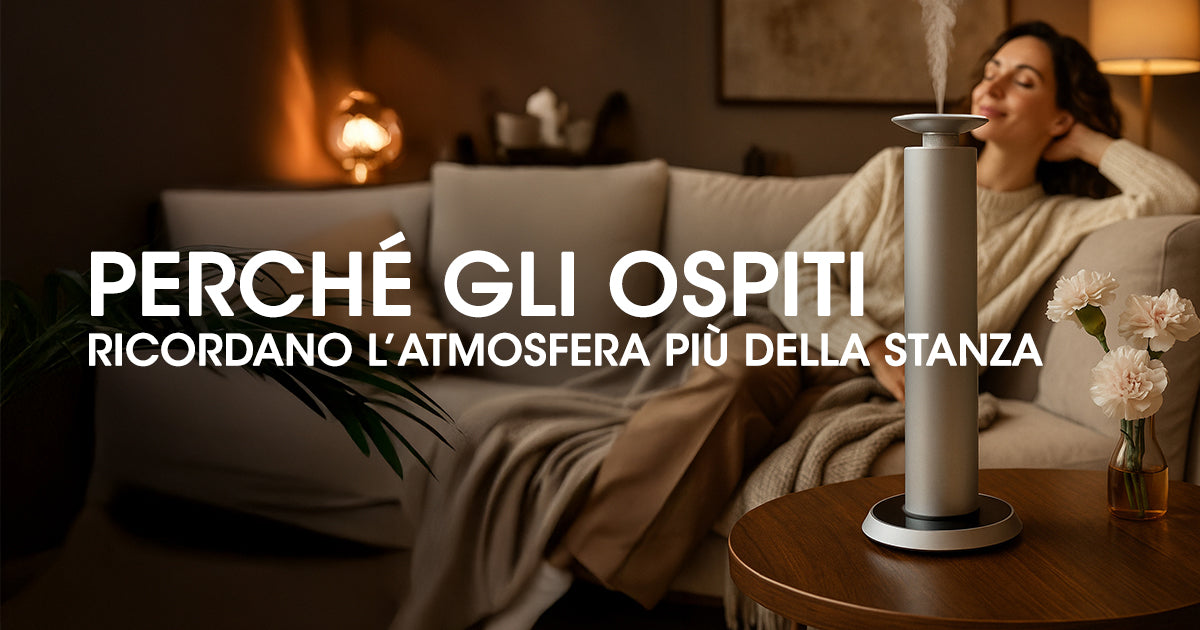
The sense of smell, in particular, communicates directly with the brain areas linked to emotion and memory. It does not require conscious attention, it does not interrupt, it does not invade. It works deeply.
The room represents the offer.
The atmosphere defines the interpretation of that offer.
And interpretation is what is remembered.
For a hospitality operator, this means something very concrete: perceived quality is not just the result of the furnishings, but of the coherence of the experience.
D — Desire
Let's imagine two properties with equivalent standards: the same category, the same level of service, the same investment in the rooms.
In one, every space is correct but disconnected.
In the other, every environment communicates the same identity.
The difference is not in the list of services, but in the feeling of continuity.
A lobby with a fragrance consistent with its positioning immediately conveys character.
A harmonious corridor accompanies without interrupting.
A lounge area with a calibrated olfactory signature fosters lingering and comfort.
It is not about intensity, but about coherence.
When this coherence is present:
-
perceived quality increases organically
-
the property appears more solid and distinctive
-
the memory becomes more stable
-
the likelihood of return grows
The guest does not analyze the reason.
But they unconsciously associate that atmosphere with a feeling of well-being.
And what is associated with well-being tends to be sought out again.
Over time, this translates into a less visible but more lasting competitive advantage: emotional loyalty.
Atmosphere as a strategic lever
In the current hotel landscape, comfort is a standard.
The difference lies in coherence.
A hotel may excel in room design and, at the same time, result in a neutral overall perception. Neutrality reduces risk, but it also reduces memorability.
Conversely, a property that designs its atmosphere as an integral part of its identity builds a unified experience. Every environment becomes a chapter of the same story.
Atmosphere does not replace the room.
It amplifies it.
It holds the guest's journey together and makes it recognizable over time.
And it is precisely this recognizability that generates real value in a competitive market.
A — Action (editorial, soft)
Designing what remains
At Triad Aroma, we observe that the most forward-thinking properties do not just limit themselves to improving rooms. They design the emotional impact of the entire stay.
Atmosphere is not a decorative detail.
It is a positioning choice.
When a hotel space is designed to generate sensory coherence, the guest does not only remember the comfort.
They remember the identity.
And in the hospitality sector, what is remembered is what builds relationships over time.


