

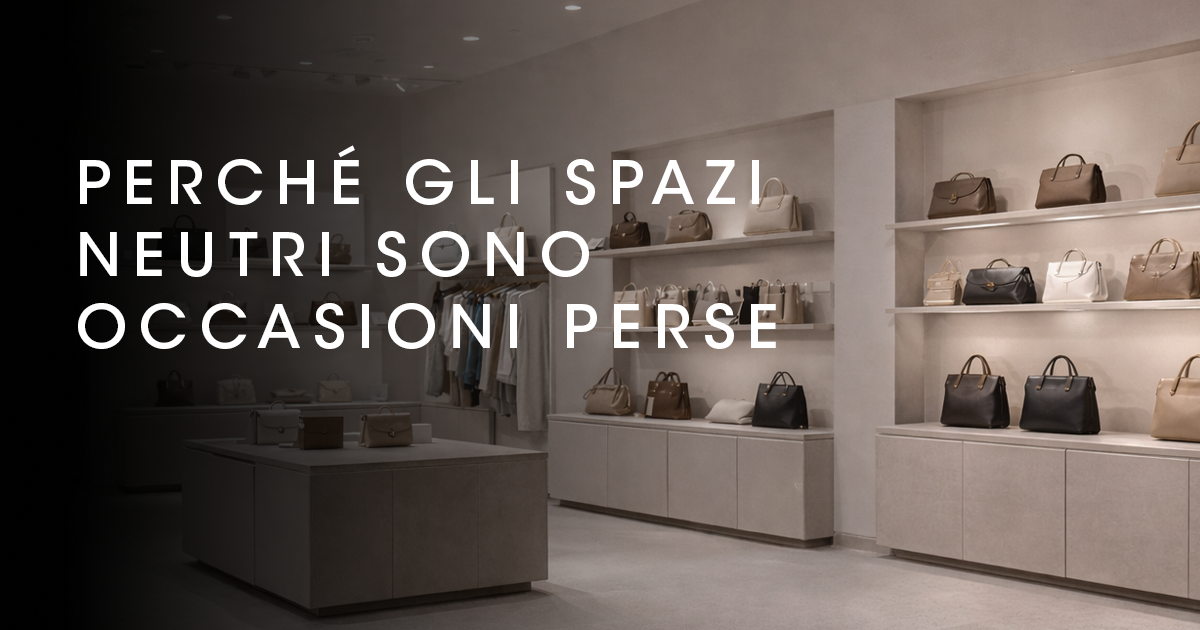
Why neutral spaces are missed opportunities
Neutrality is reassuring. But it rarely sets you apart.
We enter many spaces every day: hotels, showrooms, boutiques, executive offices. Tidy, well-kept, correct environments. Nothing out of place. Nothing that disturbs.
Yet, upon leaving, often nothing remains.
Neutrality has become a widespread choice. Desaturated tones, discreet materials, restrained atmospheres. A safe solution, designed to please everyone and offend no one.
But that which takes no stance rarely leaves a mark.
In a market where memory is a competitive advantage, neutral spaces risk being missed opportunities.
The invisible cost of indifference
The choice of neutrality often stems from a cautious logic: avoid excess, do not polarize, do not take risks. In premium contexts, this caution can seem synonymous with elegance.
However, there is a substantial difference between balance and anonymity.
A neutral space communicates little. It does not tell a vision. It does not suggest a character. It does not build a specific memory. It is functional, but interchangeable.
From a perceptual standpoint, the human mind registers what possesses coherence and identity with greater intensity. Not necessarily what is bold, but what is distinctive.
In hospitality, retail, and corporate environments, where the relationship with the client or guest is played out through subtle details, perceptual indifference can translate into emotional indifference.
And indifference does not build value.
From neutrality to presence
Designing a space with intention does not mean making it excessive. It means giving it a voice.
A hotel that chooses to express its own sensory identity is no longer just welcoming. It is recognizable. The experience is not limited to the functionality of the room or the quality of service: it becomes a coherent atmosphere.
In retail, the difference between a neutral store and one with character is not just aesthetic. It is in its staying power. When the environment possesses a defined perceptual presence, the customer engages more deeply.
In corporate spaces, anonymity communicates caution. But leadership requires clarity. An environment that truly reflects corporate culture reinforces credibility and consistency.
Finally, in wellness, neutrality can reduce the experience to a generic container. Atmosphere, conversely, can transform it into a journey.
Moving beyond neutrality means:
-
increasing the memorability of the space
-
strengthening perceived quality
-
creating a deeper emotional connection
-
aligning environment and brand identity
It is not about adding elements.
It is about defining a direction.
Neutrality is a choice. Character is, too.
At Triad Aroma, we observe how the most forward-thinking companies understand that a space is not merely a container. It is a tangible extension of their identity.
Choosing neutrality may seem like the safest path. But safety rarely generates recognizability.
In a competitive context, the difference is not between minimalism and expressiveness. It is between anonymity and intention.
When a space is designed with a clear presence, it does not need to raise its voice. It communicates with consistency.
And what communicates with consistency, over time, is remembered.


