

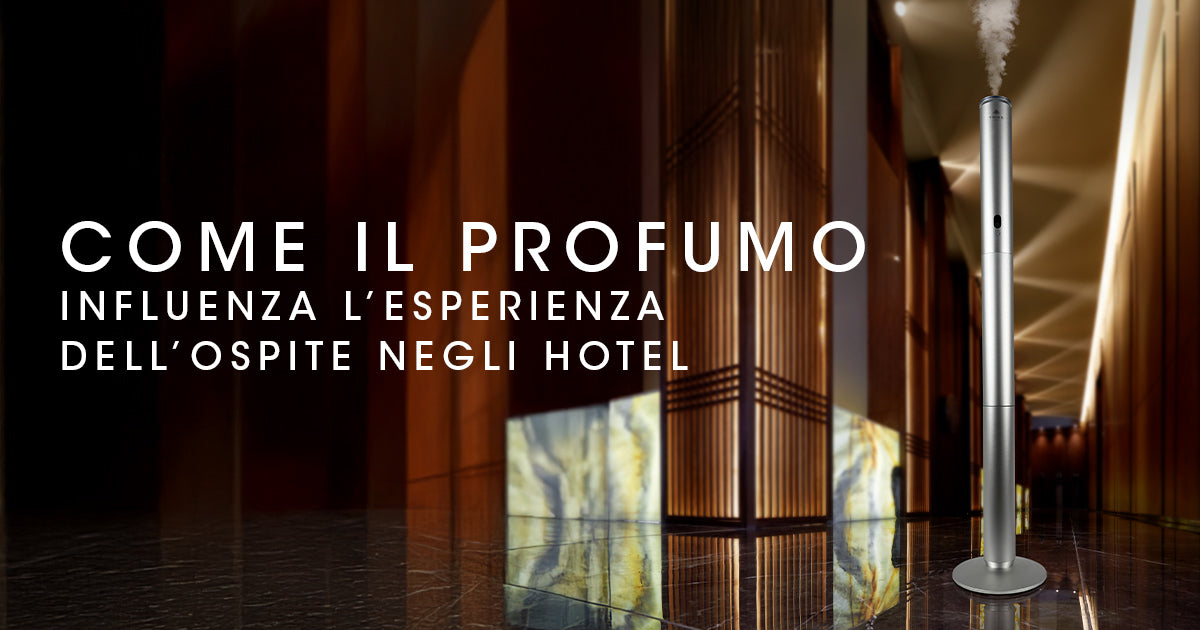
How does scent influence the guest experience in hotels?
The guest experience begins before check-in.
Not when they receive the key.
Not when they enter the room.
Not when they discover the service.
It begins the moment they cross the threshold.
The lobby might be impeccable. The design sophisticated. The lighting well-planned. Yet, what determines the first impression is not just what the guest sees. It is what they perceive.
In a sector like hospitality, where visual excellence is now a standard, the real difference is played out on a more subtle level: the atmosphere.
And scent is one of its most powerful components.
Why the sense of smell shapes perception before evaluation
In the guest journey, the emotional dimension precedes the rational one. Before judging the quality of service or the comfort of the room, the guest develops an overall feeling.
From a neuroscientific perspective, the sense of smell is directly connected to the areas of the brain responsible for emotions and memory. This means that an environment that is harmonious from an olfactory standpoint can generate an immediate, often unconscious, but decisive response.
In hospitality, this step is crucial.
A hotel does not just sell overnight stays. It sells time, comfort, experience, memory. Every detail contributes to the perception of value.
When the scent is consistent with the positioning of the property — boutique hotel, luxury, business, wellness — it strengthens the identity in a silent but incisive way.
It is not about intensity.
It is about consistency.
From the lobby to the room: perceptual continuity
A truly distinctive hotel experience is consistent throughout the entire guest journey.
The lobby is the first point of contact. A well-designed olfactory identity can:
-
convey welcome and professionalism
-
suggest luxury or contemporary minimalism
-
anticipate the atmosphere the guest will experience in subsequent spaces
But its effectiveness does not end there.
The continuity between the reception, corridors, rooms, and common areas creates an invisible thread that reinforces the memorability of the stay.
A luxury hotel might choose warm, enveloping notes to evoke exclusivity and intimacy.
A business property might opt for fresh, clean fragrances capable of suggesting efficiency and clarity.
A wellness resort might integrate natural, relaxing accords to amplify the sensation of detachment from the daily grind.
When the olfactory identity is aligned with the architecture, materials, and service, the guest perceives consistency. And consistency increases trust.
Over time, this consistency becomes memory.
And memory, in hospitality, is what drives return visits.
Scent as an element of perceived quality
In the hotel sector, quality is not just objective. It is perceived.
Two hotels can offer similar standards in terms of services. What distinguishes them is the overall feeling they leave behind.
An environment with a defined olfactory identity:
-
increases time spent in common areas
-
improves the perception of cleanliness and care
-
strengthens the recognizability of the property
-
contributes to customer loyalty
In a market where online reviews influence decisions, the emotional experience becomes a strategic competitive factor.
A memorable stay is not born from a single element, but from the coherent set of perceptions.
Designing the experience, not just the space
At Triad Aroma, we observe how the most forward-thinking hotel properties do not just focus on aesthetics. They invest in designing the experience as a whole.
Integrating an olfactory dimension does not mean adding a sensory detail. It means recognizing that the atmosphere is an integral part of the brand identity.
In hospitality, the difference between a correct stay and a memorable one is often invisible.
When a space is designed with intention, it does not just welcome the guest.
It stays with them, even after they have departed.


