

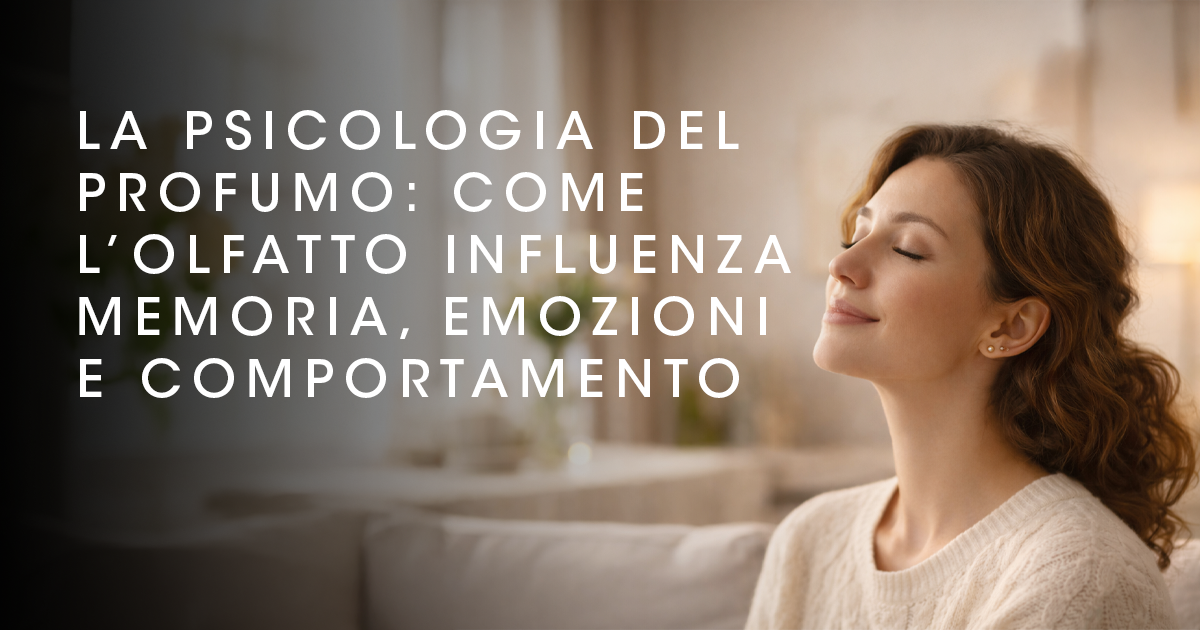
A memory can re-emerge before it is even thought of
It happens suddenly.
A scent in the air, imperceptible yet familiar, and a scene from long ago returns with surprising clarity. It is not a rational process. It is not a conscious decision. It is an immediate response.
Smell does not ask permission from the analytical mind. It goes deep, activating images, emotions, and sensations. Before a space is even observed, it is breathed in. And what one breathes in shapes the way that place will be perceived.
In physical environments—hotels, boutiques, professional offices, spas, corporate headquarters—this phenomenon is not a poetic detail. It is a concrete psychological factor that influences how people feel, remember, and make decisions.
Because the sense of smell speaks directly to the most emotional part of the brain
From a neuroscientific perspective, smell is an atypical sense. Olfactory information does not follow the same path as visual or auditory stimuli. It arrives rapidly at the limbic system, the area of the brain involved in memory and emotion regulation.
This direct link explains why:
-
A scent can evoke memories with greater intensity than an image.
-
A fragrance can generate a feeling of trust or comfort in a matter of seconds.
-
The atmosphere of a space can influence mood without the visitor being fully aware of it.
In an economic context where experience has become a competitive lever, understanding this mechanism means recognizing that perception precedes judgment. People do not evaluate a space only by what they see. They interpret it through what they feel.
For a brand, this implies a subtle but decisive responsibility: every sensory element contributes to the construction of its perceived identity. Smell, precisely because it is less obvious, can become one of the most incisive.
It is not about suggestion. It is about coherence. When the olfactory atmosphere is aligned with the architecture, the design, the visual language, and the brand positioning, the experience becomes more harmonious. And what is harmonious is perceived as more authentic.
From emotion to decision: the impact in professional spaces
The psychology of scent is not abstract theory. It is observable in daily behaviors.
In hospitality, the guest experience begins the moment they cross the threshold. An olfactorily coherent environment can immediately convey welcome, elegance, and calm. This first impression shapes the perceived quality of the entire stay. It is not just comfort. It is memorability.
In retail, smell can modulate time. Environments perceived as pleasant invite people to slow down, to explore, and to linger. Longer stays are not a mechanical effect, but an emotional consequence: when a space makes one feel at ease, the relationship with the brand deepens.
In corporate spaces, the olfactory dimension can contribute to creating focus and well-being. Offices and professional studios are no longer just operational spaces; they are environments that reflect company culture and attention to people. A coherent atmosphere supports the daily experience of collaborators and visitors, influencing perceptions of professionalism and care.
Finally, in wellness, the role of smell is almost architectural. The fragrance becomes part of the construction of the overall sensory experience. It helps mark the transition between the outside and the inside, between the urban rhythm and time dedicated to oneself. Here, scent does not just accompany the experience: it defines it.
In all these scenarios, recurring benefits emerge:
-
Memorability: a space associated with a specific olfactory atmosphere becomes more recognizable over time.
-
Perceived quality: sensory coherence and attention to detail strengthen a premium image.
-
Emotional connection: the experience becomes rooted in affective memory, not just functional memory.
-
Brand identity: scent becomes a distinctive element, part of the corporate narrative.
This is where psychology meets strategy. Understanding how smell influences emotions and behavior allows for the design of environments that do not just aim to be beautiful, but become meaningful.
Designing to be remembered
In an era where visual stimuli are multiplying and attention is fragmented, what remains is not always what is seen. Often, it is what has been felt.
The psychology of scent teaches us that memory is not just an archive of images, but a weave of sensations. Spaces that manage to enter this deep dimension do not try to impress. They seek to be coherent, intentional, and authentic.
Designing an environment today means considering all its sensory components, including those that are invisible. Smell is not an accessory, but a language. A silent language capable of steering emotions and behaviors with discretion.
When a brand decides to consciously integrate this dimension, it is not adding a detail. It is choosing to be remembered.
And what is remembered, over time, becomes a relationship.