

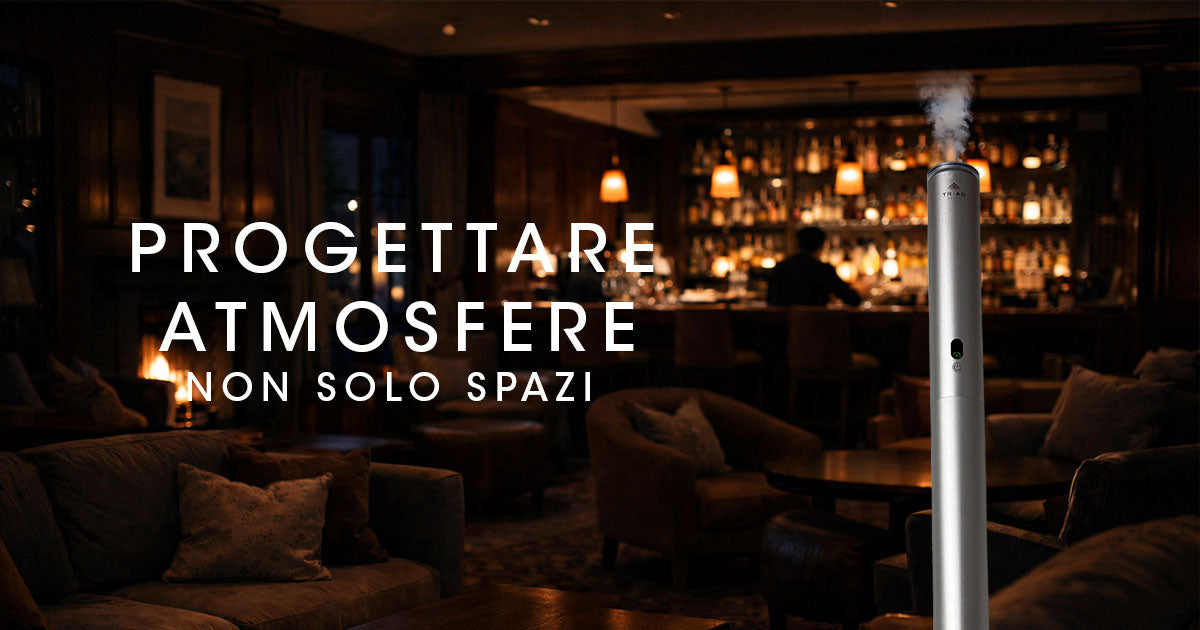
From form to perceptual depth
We live in an age where spaces are increasingly "photogenic."
Flawless renders. Sophisticated materials. Proportions calibrated for the eye. Every environment is designed to be shared, observed, commented upon.
And yet, many of these spaces turn out to be surprisingly interchangeable.
Visual quality has become a prerequisite.
Perceptual depth, on the other hand, has become rare.
The difference between a well-designed space and a memorable one is not in the form. It is in the atmosphere.
Contemporary interior design has reached an extremely high technical level. But this widespread excellence itself has created a new problem: homogenization.
Neutral palettes, natural materials, indirect light, controlled minimalism. Correct, coherent, refined languages.
But what happens when design stops at the visual dimension?
The experience of a space is not two-dimensional. It is immersive. It involves the body, memory, and emotional state.
Designing an atmosphere means working on what is not immediately visible, yet determines the overall quality of the experience.
This is where the olfactory dimension becomes relevant.
Not as decoration.
As a perceptual layer.
Atmosphere as an intentional construction
An atmosphere does not arise by chance. It is the result of a precise alignment between:
- volumes and proportions
- materials and textures
- light and shadow
- sound and silence
- air and olfactory perception
When one of these levels remains neutral, the space loses density.
Integrating the olfactory dimension means adding depth. It means working on air quality as an integral part of the project.
Not to "scent," but to make the experience coherent.
From project to lived experience
Many spaces are designed to be observed.
Few are designed to be inhabited.
Atmosphere is what transforms a design into an experience.
A calibrated fragrance can:
-
reinforce the feeling of warmth or rigor
-
amplify intimacy or monumentality
-
support the narrative identity of the space
-
create continuity between different environments
When these elements are harmonized, the space does not merely remain aesthetically correct.
It becomes recognizable.
The responsibility of the designer
Designing atmospheres means taking on a broader responsibility.
Not just drawing forms, but shaping perceptions.
At Triad Aroma, we observe how the most evolved studios and brands are starting to consider air as a design material. Invisible, yet decisive.
The quality of a space is not just in the precision of the lines.
It is in the coherence of the feeling it leaves behind.
Perhaps the true evolution of design is not in aesthetics, but in awareness.
Designing atmospheres means moving beyond the idea that space is only surface.
It means recognizing that every environment also communicates through what is unseen.
When the atmosphere is constructed with intention, the space is not just photographed.
It is remembered.
And what is remembered becomes identity.


