

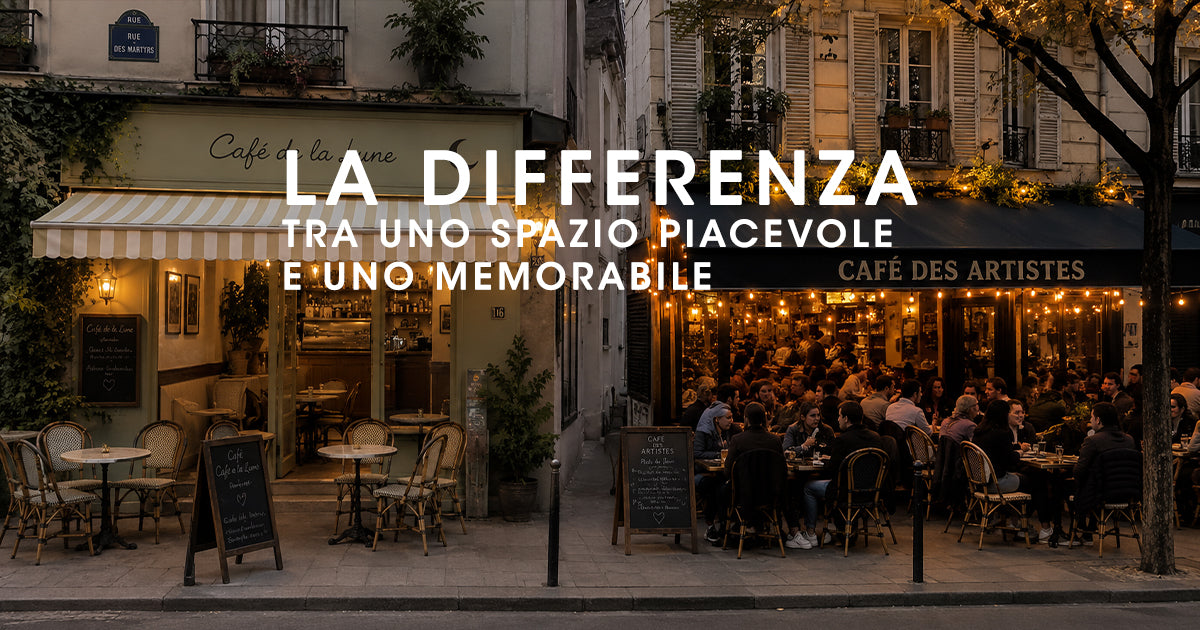
Many spaces are well-designed. Few leave a lasting impression.
We enter well-kept hotels, elegant boutiques, and contemporary offices. Everything appears in order: coherent materials, calibrated lighting, and carefully chosen furnishings. The experience is pleasant, proper, and often even refined. Yet, a few days later, the memory fades. Not because quality was lacking. But because something deeper was missing: a presence.
A space can be beautiful without becoming memorable. The difference does not always lie in visible design, but in the ability to create a consistent experience that is perceptible on an emotional level.
This is where the sensory dimension comes into play.
In designing contemporary environments, architecture and interior design have reached extraordinary levels of excellence. Visual quality is now widespread and accessible. Precisely for this reason, standing out through aesthetics alone has become increasingly difficult. Our brain, however, does not simply remember what it sees. It remembers what it feels. The neuroscience of experience shows that memory is built through the combination of sensory stimuli. Among these, smell plays a unique role: it is directly connected to the brain areas that regulate emotions and memories. This means that a fragrance is not simply perceived.
From pleasantness to recognizability.
Let us imagine two spaces with similar characteristics: contemporary design, quality materials, attention to detail. In the first, everything is aesthetically correct. The experience is pleasant but neutral.
In the second, every element contributes to creating a coherent atmosphere: lights, sounds, materials, and scent dialogue with each other.
The difference is not immediately explainable. Those who visit the first space will say: It is very beautiful. Those who visit the second will say: There is something special. That feeling of “something” often arises from the sum of the invisible perceptions that accompany the experience.
A pleasant space satisfies a need.
A memorable space builds a bond.
Atmosphere as a strategic element
In an increasingly competitive market, the real difference is rarely found in the most obvious elements. Many brands invest in the visual quality of their environments, but few consider atmosphere as a full-fledged design component. Yet, it is precisely the atmosphere that unites the elements of a space into a coherent experience. When light, materials, sounds, and scent dialogue with one another, the environment ceases to be merely functional. It becomes recognizable.
At Triad Aroma, we observe every day that the most successful spaces are not necessarily the most spectacular. They are those in which every element contributes to creating a coherent sensation. The olfactory dimension, when designed with precision and sensitivity, does not dominate the experience; it supports it. It is a silent language that accompanies people without interrupting their journey. When a space manages to speak on a sensory level in a harmonious way, something simple yet powerful happens: people do not just remember where they have been. They remember how they felt.
And this is precisely what transforms a pleasant space into a memorable one.


