

Entering a space is not a single moment. It is a journey.
First there is the entrance, then orientation, then the stay. Each phase has a different rhythm, a different goal, a different state of mind. Yet, in many environments, all these moments are treated as if they were identical. The reality is that the experience of a space is not static: it is a sequence. And when the sequence is carefully designed, every element—light, materials, sound, and scent—can accompany this journey in a consistent way.
In contemporary interior design, there is increasing talk of a physical customer journey. It is not just about aesthetics, but about perception over time.
A guest entering a hotel, a customer walking through a store, or a visitor accessing an office does not experience a single space: they move through environments with different functions: welcome, transition, stay, relaxation, decision. Each of these moments generates a different state of mind. For this reason, the most advanced sensory design does not consider space as a single block, but as a sequence of environments with complementary identities.
When it makes sense to differentiate:
Differentiating the fragrance between different areas does not mean changing identity. It means adapting it. It is a principle similar to that used in visual branding: a brand maintains consistency while adapting to different contexts. In physical spaces, this can translate into: a lobby that communicates openness and welcome, corridors that accompany with discretion, lounge areas that encourage lingering, and wellness zones that suggest relaxation.
When this dynamic consistency is designed correctly, the space acquires a quality that is difficult to replicate. The guest does not perceive abrupt changes. They feel a continuity. The experience becomes more natural. Differentiation is not intended to "shock."
It serves to guide the experience without interrupting it. And it is precisely this discretion that makes it effective.
The role of design:
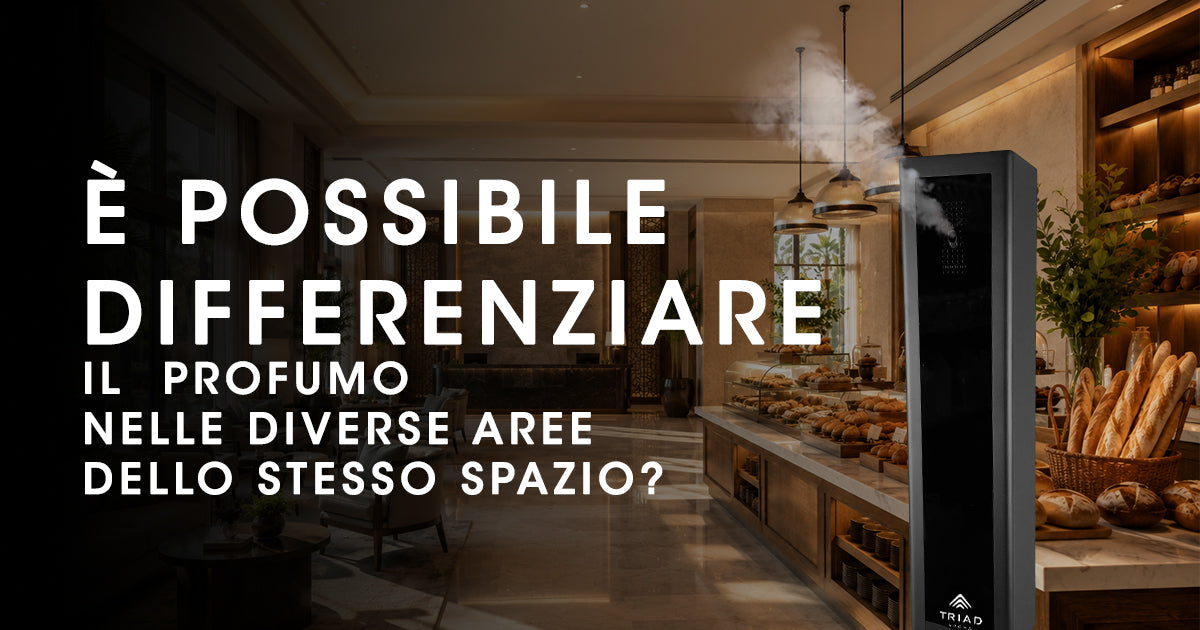
Integrating different fragrances into the same environment requires technical attention. It is not enough to simply choose multiple scents. It is necessary to consider: dimensions and configuration of the spaces, ventilation systems, people flows, distances between areas, and intensity of diffusion. When these elements are precisely calibrated, the fragrances do not compete with each other—they collaborate. And the space becomes a coherent perceptual ecosystem.
At Triad Aroma, we observe that the most attentive companies do not simply look for a fragrance. They design the experience of the space. Differentiating the atmosphere between different areas does not mean multiplying sensory elements, but orchestrating the guest's journey with greater awareness. When each environment contributes to the same identity, the space does not just function. It becomes memorable.


