

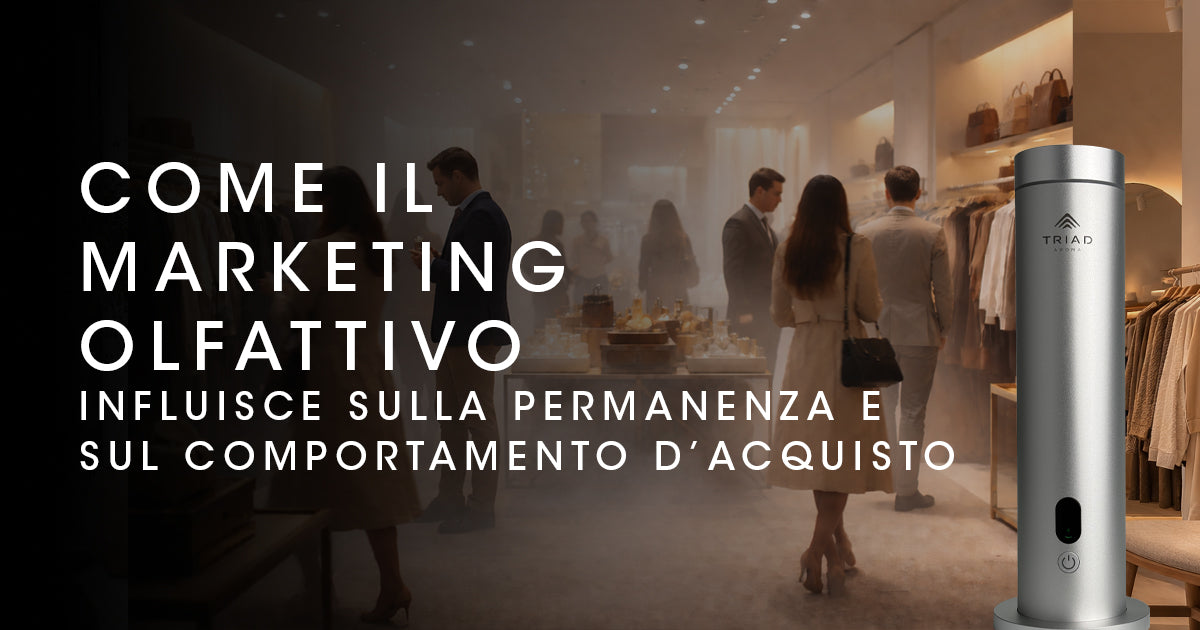
Beyond aesthetics: how olfactory marketing impacts dwell time and purchasing behavior in fashion retail
In high-end retail, the true indicator of value is not foot traffic.
It is dwell time.
In a market where visual presentation is increasingly curated and standardized, aesthetics are no longer enough to retain customers. Many stores attract, but not all succeed in engaging.
And that which does not engage does not build a relationship.
The difference is not in the initial impact. It is in the ability to transform a visit into an experience.
Purchasing behavior in premium fashion retail is deeply emotional. You are not just buying a garment: you are buying a projection of yourself.
In this process, the environment plays a decisive role.
The sense of smell, directly connected to the brain areas that regulate emotion and memory, acts before analytical reasoning. It does not demand attention. It guides the state of mind.
An olfactorily consistent environment can:
- reduce the perception of haste
- foster spontaneous exploration
- increase decision-making comfort
- make the experience more immersive
It is not about aggressive stimulation.
It is about creating the conditions in which the choice becomes natural.
For a high-end brand, this means governing not just the image, but the pace
Dwell time as a strategic lever
In luxury retail, time is not an operational detail. It is a value multiplier.
The longer a client stays in the boutique:
- the greater the interaction with the product
- the higher the likelihood of trying it on
- the more the immersion in the brand's world is consolidated
A consistent olfactory signature helps to stabilize the experience. It reduces cognitive tension, makes the space more harmonious, and fosters qualitative dwell time.
When perceived time expands, the relationship deepens.
From dwell time to decision
Purchasing behavior in the premium segment is not impulsive. It is identity-driven.
A decision made in a state of emotional comfort tends to be more secure, more consistent, and less subject to second-guessing.
Olfactory marketing does not “persuade”.
It creates the context in which conviction can form.
In a consistent space:
- the product appears more integrated into the brand's universe
- the client feels part of that world
- the choice becomes a personal statement
The difference between an aesthetically curated store and one that is strategically designed lies right here: in the ability to influence behavior without forcing it.
Consistency as a competitive advantage
In international fashion retail, many stores share a similar visual language. Clean lines, refined materials, controlled minimalism.
When visuals tend toward homogenization, distinctiveness shifts to other levels.
The olfactory dimension can become an invisible but structural signature. Not to overwhelm, but to consolidate.
At Triad Aroma, we observe how the most conscious brands use atmosphere as a positioning lever. Not to add a sensory element, but to strengthen consistency and depth.
The result is not just longer dwell time.
It is higher quality of the relationship.
In high-end retail, performance is not measured solely in immediate conversion. It is measured in the quality of the experience that precedes the choice.
Integrating an olfactory strategy means taking responsibility for designing what happens before the decision.
When a space is designed to guide the rhythm, foster concentration, and stabilize emotion, dwell time is not accidental.
It becomes a consequence.
And in the long run, what is the consequence of intentional design transforms into structural value.


