

Every space has a balance.
A balance between volumes and proportions, between light and shadow, between sound and silence. When this balance is fragile, even a detail out of place can compromise it.
The olfactory dimension is no exception.
Designing an olfactory environment does not mean “adding fragrance”.
It means intervening in a complex system without altering its harmony.
It is an act of precision.
In our work, we often observe a misunderstanding: people think that choosing a fragrance is a matter of taste.
It is not.
Taste is personal.
Perception is strategic.
Before proposing any olfactory signature, we analyze the space as an organism: its architecture, materials, flows, function, and the target audience that inhabits it.
Every environment already communicates something.
The fragrance must amplify that message, not contradict it.
An incoherent scent creates dissonance.
A calibrated fragrance creates continuity.
Structural Analysis
Our approach always starts with analysis.
We evaluate:
- volumetry and air distribution
- dominant materials and perceived temperature
- levels of natural and artificial light
- density of presence and occupancy
These elements define the “sensory matrix” of the space.
Without this preliminary reading, any choice would be random.
Identity Translation
Subsequently, we translate the brand positioning into coherent olfactory codes.
We do not ask: “What scent do you like?”
We ask: “What perception needs to be consolidated over time?”
Solidity, dynamism, elegance, hospitality: every value requires a precise composition.
The fragrance becomes an invisible language that reinforces what the brand already declares visually.
Calibration and control
The most delicate phase is calibration.
An effective olfactory environment must be:
- perceptible but not invasive
- constant but not static
- coherent across different environments
Intensity is a technical matter, not a subjective one.
The goal is not to be noticed.
It is to support the experience without interfering.
Perfection, in this field, is discreet.
The importance of balance
At Triad Aroma, we consider air a design material.
Like light, it can amplify or flatten.
Like sound, it can create comfort or tension.
That is why our method does not seek scenographic effects, but perceptual stability.
A well-designed space should not constantly surprise.
It must function over time.
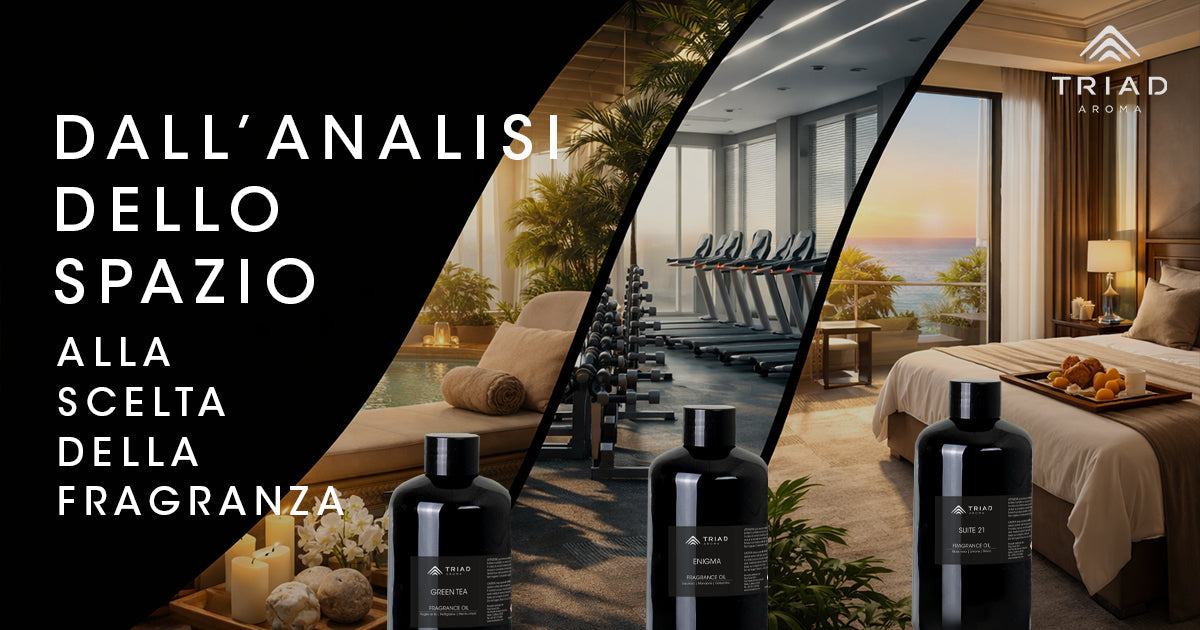
From the analysis of the space to the choice of the fragrance, every phase requires rigor.
The olfactory dimension is not an accessory element, but a design layer that deserves the same attention as any other system.
When method precedes aesthetics, the result is not just coherent.
It is solid.
And what is solid, over time, becomes identity.


